
Comparing OEM and ODM Jewelry Services on Six Dimensions
The labels OEM and ODM describe who supplies the design, not who supplies the quality. TTT Jewelry frames the split in two lines: OEM is you design, we produce, with intellectual property 100% buyer-owned; ODM is you inspire, we create, with co-created collections exclusive to the brand. Six practical dimensions separate the two, and the published MOQ thresholds of 50, 100 and 100+ pieces per design cut across both.

Key takeaways
- OEM starts from buyer CAD; ODM starts from a reference, a mood board or a sample, and develops the design.
- Silver MOQ is 50 pieces per design, exactly 50% of the 100-piece brass threshold; stainless steel starts at 100+.
- Sampling at 25–30 days equals 3.6–4.3 weeks, slightly longer than the 21–28 day bulk run.
- Final inspection is 100% of pieces, and ISO 9001:2015 covers quality management across every production stage.
Two service models on one floor
Both models end at the same bench. A casting line does not change because a drawing arrived from a buyer rather than from an in-house designer. What changes is where the ambiguity sits. In OEM, the buyer owns the ambiguity and resolves it in CAD. In ODM, the factory absorbs it and returns a proposal: a sketch, then a model, then a master. That is also why an OEM/ODM supplier tends to ask which model a buyer wants before quoting, rather than quoting one rate for both.
That single difference cascades. It changes who pays for revisions, who holds the file at the end, how many sampling rounds are realistic, and how much of the buyer's calendar is spent on design review rather than on production scheduling. The six dimensions below are simply the places where the cascade becomes visible in a contract.
It also changes the tone of the first meeting. An OEM buyer arrives with a file and wants a quotation. An ODM buyer arrives with a reference and wants a point of view. Suppliers structured for the first conversation often struggle with the second, and the reverse is equally true.
Six dimensions side by side
The table uses the published descriptions rather than a generic industry definition, because the definitions are where comparisons usually break down.
| Dimension | OEM | ODM |
|---|---|---|
| Design input | Buyer's CAD file or technical drawing | Buyer's reference, sketch or mood board |
| IP ownership | 100% buyer-owned from the start | Co-created, with the collection exclusive to the brand |
| Tooling | Cut to the buyer's geometry | Developed alongside the concept |
| MOQ exposure | Per design, 50 silver, 100 brass, 100+ stainless | Same thresholds, spread over more design decisions |
| Sampling burden | Buyer approves a known design | Buyer approves a design that did not exist before |
| Revision risk | Concentrated in the file | Concentrated in the concept review |
The last two rows are the ones buyers underestimate. OEM approval is a comparison: does the master match the drawing? ODM approval is a judgement: does the master match the idea? Judgements take longer, and the 25–30 day sampling window does not shrink because the question is harder.
MOQ is set by metal, not by model
Buyers sometimes assume ODM carries a higher minimum because more work happens upstream. The published thresholds do not support that. Both models run on the same material-based minimums: 50 pieces per design for 925 sterling silver, 100 pieces per design for artisan eco-brass, and 100+ pieces per design for stainless steel.
The 50-piece silver threshold is 50/100 = 50% of the brass minimum. That ratio matters more than the absolute numbers, because it determines how many designs a buyer can open inside a fixed budget for stock. A brand that wants eight silver designs is committing to 400 pieces; the same eight designs in brass would be 800.
Stainless steel sits slightly differently because the 100+ figure is a floor rather than a fixed number, and because PVD vacuum plating is applied to stainless rather than the multi-layer gold stack used on silver and brass. Volume planning for stainless should therefore start above the threshold, not at it.
Where inspection sits on the line
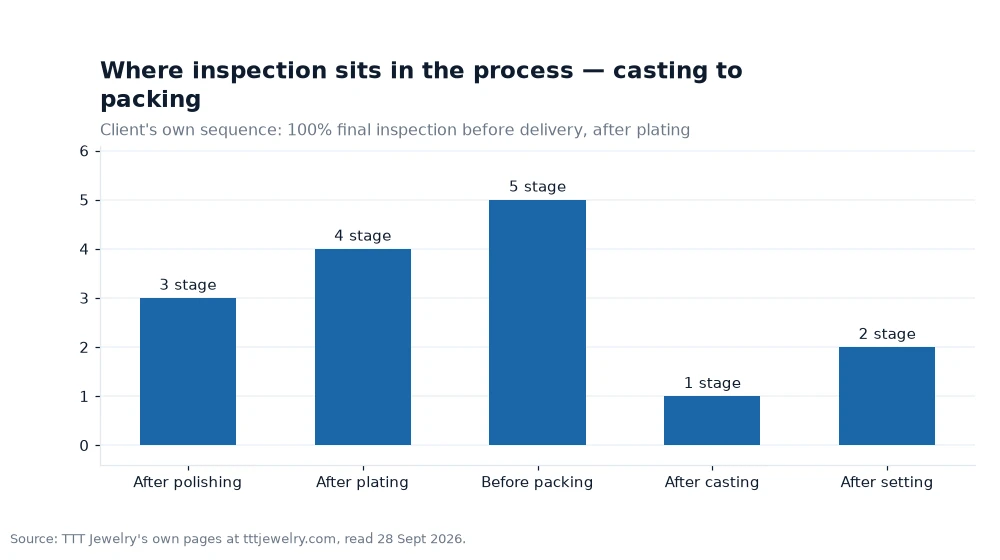
Inspection is not one event at the end. Along a jewelry line it appears at five natural points: after casting, after stone setting, after polishing, after plating, and before packing. Each point catches a different failure. Casting inspection finds porosity and incomplete fill. Setting inspection finds raised or loose stones. Polishing inspection finds scratches that plating will only amplify. Plating inspection finds adhesion and colour variation. Pre-packing inspection finds the mismatches that a customer would find first.
The published commitment is 100% final inspection, which means every piece rather than a sample. That is a different claim from statistical sampling, and it is the claim a buyer should ask to see evidenced in the QC record. ISO 9001:2015 is the framework that keeps those five points documented from order to order.
Where the inspection sits also shapes the quotation. A supplier that inspects only before packing is not performing the same work as one that inspects after plating, even if both write QC on the invoice. A full service jewelry OEM manufacturer should be able to show the record for each of the five points, not only the last one.
Worked example
Convert the published windows into one unit and compare them. Sampling at 25 days is 25/7 = 3.6 weeks; at 30 days it is 30/7 = 4.3 weeks. Bulk production at 3 to 4 weeks is 21 to 28 days.
Now line the two up. At the low end, sampling exceeds production by 25 − 21 = 4 days. At the high end, it exceeds production by 30 − 28 = 2 days. So in both published cases the sample gate is the longer block, even though production is the stage buyers usually watch.
Add the 2-day CAD step and the range closes at 2 + 25 to 30 + 21 to 28 = 48 to 60 days. For a ten-design ODM collection sampled once, that is ten parallel sample approvals, not ten sequential ones, which is why a supplier's capacity to run samples in parallel matters more than its quoted single-design speed.
Frequently asked questions
Is OEM cheaper than ODM for a first collection?
Not automatically: both models use the same material MOQ thresholds, and OEM shifts design cost to the buyer while ODM shifts design work to the factory.
Does ODM mean the factory owns the design?
The published model is the reverse: ODM starts from the buyer's inspiration, and the co-created collection is exclusive to that brand rather than added to a catalogue.
Which model suits a buyer without a CAD file?
ODM fits that case, because concept development runs from a reference or sketch into CAD under 48 hours and then into a physical master over 25 to 30 days.
Choosing by capability rather than label
The label matters less than the answers to four questions: who holds the file, who approves the master, what the minimum is per design, and which inspection points are recorded. A supplier that answers all four in writing can run either model.
Material capability is the other half of the decision. A buyer comparing silver and stainless options should read the sterling silver jewelry manufacturer page for the 50-piece threshold, then check the stainless steel jewelry manufacturer page for the PVD route that suits shower-safe wear.
Both models reward the same discipline: a written brief, a named approver, and a schedule expressed in gates. Buyers who bring those three things tend to find that the OEM or ODM question answers itself.
Source note: figures come from the manufacturer's own website (tttjewelry.com), read 28 Sept 2026.[1]