
Before the First Call on a Department Store Fragrance Line: What to Bring
The first call with a fragrance factory usually goes well or badly in the first ten minutes, and what decides it is what you brought to the call rather than how much perfumery you already know. A first-time founder does not need a finished scent. They need a clear picture of the retail channel, a price target with a range, a rough volume, a launch window and one or two material directions the factory can react to. Everything else can be built together, which is why preparation is mostly about making a handful of decisions the founder was going to have to make anyway. Arriving with those decisions half-made turns the call from a pitch into a working session, and the brief writes itself afterwards.
Key takeaways
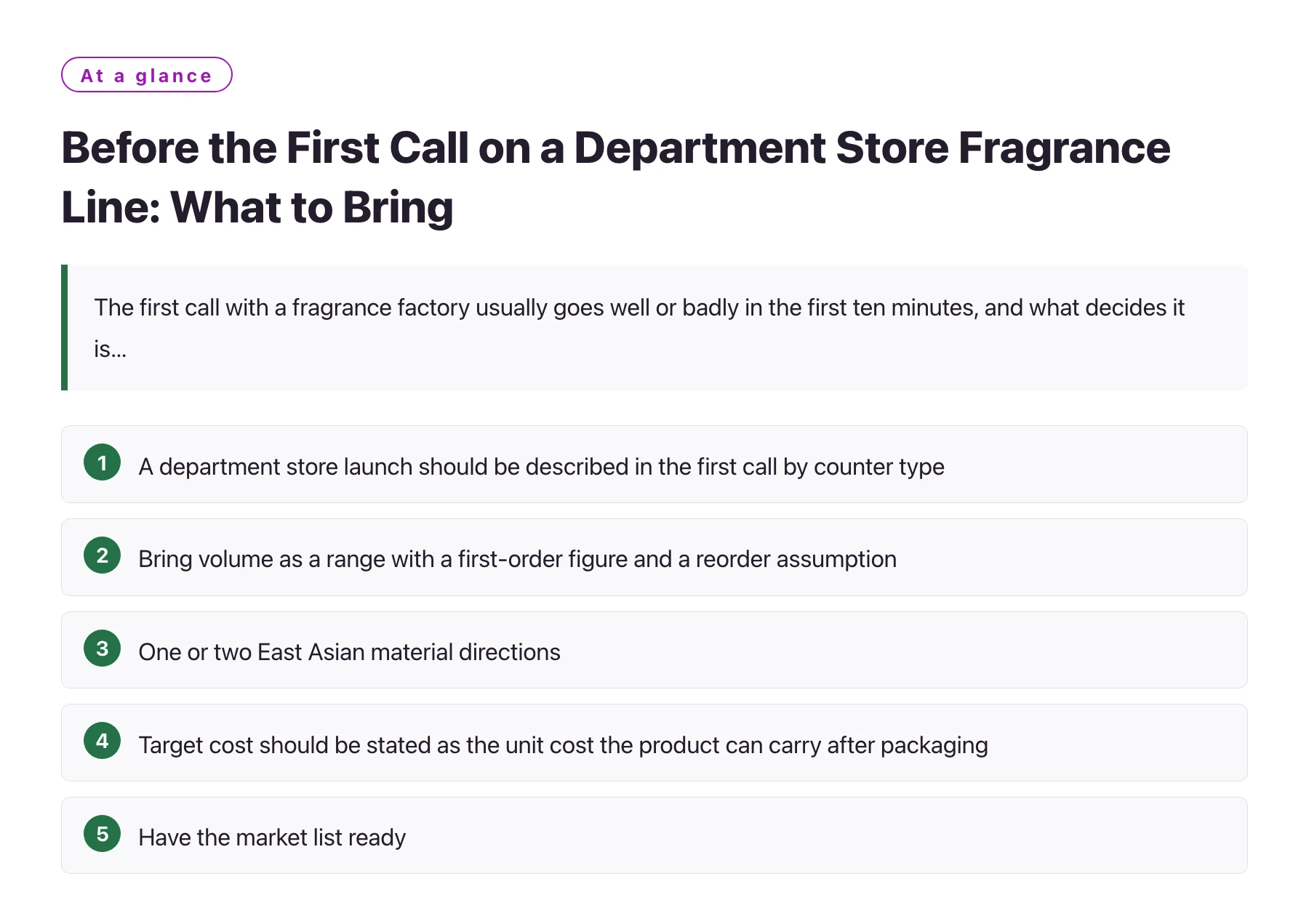
- A department store launch should be described in the first call by counter type, price band and launch window, because those three facts shape the development brief more than any note list does.
- Bring volume as a range with a first-order figure and a reorder assumption, since minimum order quantities, tooling and unit cost all move with volume.
- One or two East Asian material directions, whether osmanthus, tea, jasmine, sandalwood or ginger, give the call something concrete to work with and surface cost and restriction questions early.
- Target cost should be stated as the unit cost the product can carry after packaging, retail margin and freight, not as the price the brand hopes to pay the factory gate.
- Have the market list ready, because labelling and restricted-material positions follow where the product is sold rather than what the scent smells like [1].
- Finish the call by asking what the factory needs from you to produce a quotation, and write the answer down, because that list becomes the brief you send the same week.
Most first calls between a new brand and a fragrance factory fail for a boring reason. The founder describes a feeling, the factory hears a request without a budget, a volume or a date, and the conversation ends politely with an invitation to send more information. Nothing is wrong with either party. The information simply was not ready, and neither side can price work that has no retail context attached to it.
A department store launch raises the bar on that context. The channel sets a price ceiling, a packaging expectation and a launch calendar that a pharmacy line or an online-only line does not impose. A buyer at a department store is comparing the product with established houses, so the brief has to answer questions about positioning and price before it answers questions about notes. That is why the preparation list below starts with commercial facts and only reaches scent last.
The same applies to the material direction. A first-time founder who names a family and a reference, including one East Asian direction such as osmanthus, tea or sandalwood, gives the factory something real to cost. The founder does not need to know whether osmanthus absolute is the right choice; that is precisely the question the call exists to answer. They only need to say that the line sits in that territory and let the factory explain what the territory costs.
What to have ready before you dial in
| What to prepare | Why the factory asks for it | Minimum viable version |
|---|---|---|
| Retail channel and counter position | A department store line has a different price ceiling and packaging expectation from a pharmacy line or an online-only launch, and the difference changes the formula budget | One sentence naming the store type, the city or cities, and where the product sits on the counter next to what |
| Target retail price and the cost it implies | Price decides the formula budget, the bottle and the margin structure, and no realistic direction can be suggested without it | A price band, plus the unit cost that fits inside it once packaging, retail margin and freight are deducted |
| Volume estimate | Minimum order quantities, tooling, material buying and lead time all scale with volume, and a range is enough to begin | A first-order figure and a rough annual number, both expressed as ranges rather than single numbers |
| Launch date and retail calendar | Development, testing, filling and packaging lead times run backwards from the shelf date, and the calendar may fix that date for you | A month for the on-shelf date and the latest acceptable delivery date to your warehouse or consolidator |
| Category and format | Fine fragrance, home fragrance and scented body products are developed, tested and regulated differently, so the format decides the work | The exact product types and pack sizes in the first order, even if only two or three items are planned |
| A material direction, including East Asian notes | Concrete references let the factory quote real materials instead of guessing, and they expose cost and restriction questions early | Two or three reference fragrances or note families, with at least one osmanthus, tea, jasmine, sandalwood or ginger direction named |
| Markets and compliance needs | Labelling, restricted materials and documentation depend on where the product is sold, and retailer requirements sit on top of that | A list of target countries and any retailer-specific requirement already known, even if it is only a labelling rule |
Nothing on this list requires a finished fragrance or a technical vocabulary. It is all information the founder either already has or can decide in an afternoon, and bringing it changes the tone of the call from an exploratory enquiry to a project discussion. It is also the shortest route to the questions that actually matter, which is what the questions to ask a perfume factory sets out in more detail.
How to run the call itself
- Start with the retail facts, not the scentOpen with the channel, the price band, the volume range and the shelf date, in that order. These four facts tell the factory which development path is even possible, and they let the person on the other side give you usable answers instead of general encouragement.
- Offer a direction, not a specificationDescribe the shelf context and two or three reference scents, including one East Asian direction if that is where the brand sits, and then let the factory translate that into materials and tell you what it costs. A founder who arrives with a formula instruction has closed off the cheapest part of the conversation. It also helps to know beforehand how a manufacturer that builds custom scents sequences the work from brief to bulk, because that sequence tells you which of your questions belong in this call and which belong later.
- Ask what the price actually includesFilling, packaging, decoration, testing, documentation and freight are the usual places where a quotation and a total cost diverge. Ask which of them are inside the number being discussed and which would be billed separately, so the comparison with your target unit cost is honest.
- Raise restrictions and testing earlyAsk which materials in a likely direction carry use limits for your product categories, and what testing the factory would commission before production. Both are quiet, inexpensive questions at the first call and expensive discoveries after the formula has been approved.
- Close by agreeing the next documentAsk what the factory needs from you to produce a quotation and when they can send it. Write the list down during the call. The follow-up brief is then a matter of filling in what you already agreed, rather than a fresh document that restarts the conversation.
The most common mistake on a first call is saving the launch date and the retail price until the end, as if they were the awkward part of the conversation. They are the most useful things a first-time founder can say, because they allow the factory to rule options in or out immediately. A second mistake is treating the call as a test the founder can fail. The factory is not assessing perfumery knowledge; it is trying to work out whether a realistic product can be built against your price and date, and an honest range is more useful to them than a confident number you cannot hold. If you want to walk in already knowing how a development programme is normally sequenced, ask for More details on that sequence before the call and read the process pages of a manufacturer such as Xuelei, which describes 31 years of fragrance manufacturing in Guangzhou and states ISO 22716 along with other certifications. It makes the questions sharper and the meeting shorter.
Sources
- Cosmetics Business —— A trade publication covering the beauty and cosmetics industry, including fragrance launches and regulatory developments.
Frequently asked questions
Do I need a finished fragrance before the first call with a factory?
No, and arriving with a fully specified formula is more likely to slow the project down than help it. What the factory needs is the retail context, a price band, a volume range and a direction it can cost. The first call is the right place to find out which interpretation of that direction is affordable, and the development work follows from there.
What if I do not know my order volume yet?
Give a range and label it as an estimate. A first-order figure and a rough annual figure are enough to discuss minimum order quantities, tooling and material buying, and both can be revised once the price and the packaging are settled. A range you will refine is more useful than a single number you cannot defend.
Should I mention East Asian materials on a first call if I am not sure about them?
Yes, if that is where the brand's positioning sits. Naming a direction such as osmanthus, tea, jasmine, sandalwood or ginger lets the factory tell you what the natural and rebuilt versions cost and which product categories constrain them. That information is exactly what the call is for, and it is much cheaper to gather now than after a sample round.
How should I describe a department store launch to a factory?
Name the store type, the cities, the price band and the shelf date, then describe what the product will sit beside. A department store counter imposes a packaging and price expectation that a smaller channel does not, and stating it up front prevents a development direction that would never fit the counter it is meant for.
What should I send after the first call?
A short brief containing the retail facts, the price and volume ranges, the launch window, the product formats, the markets and the material directions you discussed, with the open questions listed separately. If the factory gave you a list of what it needs to quote, answer that list item by item and note anything still undecided rather than inventing an answer.
How many fragrance factories should I call before choosing one?
Enough to see how differently the same brief is handled, which for most first projects means two or three. Compare the questions each one asks, what they say a quote includes and how clearly they explain material trade-offs. A factory that answers the retail context directly is usually easier to work with than one that only talks about scent.